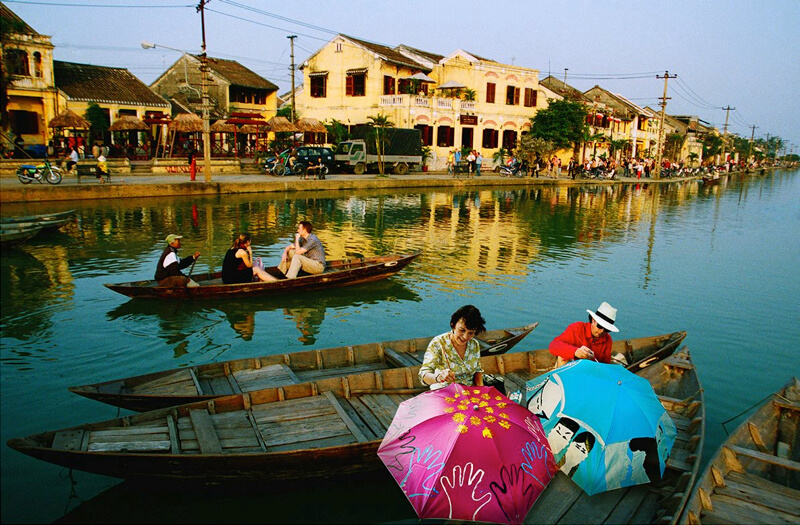

Hoi An – A Timeless Tranquility
Hoi An – a place where life flows gently and calmly. Here, the passage of time seems powerless to erase the ancient atmosphere. Moss-covered tiled roofs, streets adorned with red lanterns, intricately carved plaques—all transport visitors back several centuries. This is just a glimpse of the charm of Hoi An’s ancient town, yet it is enough to make anyone fall in love and lose track of time. This article, Introduction to Hoi An Ancient Town, offers a clear view of what makes Hoi An special.
1. Introduction to Hoi An Ancient Town
Hoi An Ancient Town is a historic urban area located along the lower Thu Bon River in the coastal plains of Quang Nam Province, Vietnam, about 30 km south of Da Nang City. The town contains many streets and buildings constructed from the 16th century, almost perfectly preserved to this day. In Western historical documents, Hoi An was known as Faifo. The town was recognized as a UNESCO World Heritage Site in 1999 and has since attracted numerous tourists visiting Da Nang and Hoi An.
Cultural Value of Hoi An Ancient Town
As the only traditional Southeast Asian trading port in Vietnam and a rare example worldwide, Hoi An has preserved over a thousand architectural monuments, including streets, houses, assembly halls, communal houses, temples, family shrines, wells, and tombs. Visitors can admire structures that reflect both traditional Vietnamese artistry and cultural exchanges with Eastern and Western countries.
Most houses are traditional architectures dating from the 17th to 19th centuries, aligned along narrow streets. Religious and spiritual buildings intermingle among homes, reflecting the town’s formation, development, and occasional decline. Hoi An also showcases cultural fusion: Chinese assembly halls and temples sit alongside traditional Vietnamese houses and French-style buildings. Beyond architecture, Hoi An preserves a rich intangible cultural heritage, including daily life customs, folk arts, and festivals, making it a living museum of urban architecture and lifestyle.
2. Description of Hoi An Ancient Town
Traditional Architecture
Hoi An is famous for its harmonious traditional architecture, blending houses, walls, and streets. Despite the challenges of history, the town retains its serene, rustic charm, reflected in tiled roofs, bricks, and trees—mirroring the simplicity and sincerity of its local residents.
House Styles
The most common houses in Hoi An are one- or two-story tube houses, narrow in width and long in depth. Materials are durable to withstand the harsh climate and annual floods. Houses typically have wooden frames with brick walls on either side. The average width is 4–8 meters, with depths ranging from 10–40 meters depending on the street. Common layouts include: sidewalk, veranda, main house, side house, bridge, and courtyard with rear house and garden.
Roofs
Most houses have two separate roofs for the main and side houses. Rarely does the main house roof cover the side house. Bridges often have four-sided roofs. Roof tiles are thin, square clay tiles, slightly curved, each side about 22 cm. They are laid in alternating rows, one up and one down.
Streets
The streets are arranged in a grid pattern, short and scenic, winding around the houses. Walking through these quiet streets, visitors can enjoy local food and experience the peaceful, simple life of Hoi An residents.
3. Notable Historical Sites
Japanese Covered Bridge (Chùa Cầu)
The Japanese Covered Bridge is an iconic symbol of Hoi An. Located at the intersection of Nguyen Thi Minh Khai and Tran Phu streets, it was built in the mid-16th century by Japanese merchants. The bridge is a unique and representative architectural work of the town.
Tan Ky Ancient House
This nationally recognized heritage site is the only one that has welcomed state leaders and diplomats. The house blends Chinese, Japanese, and Vietnamese architectural styles. Its tube-house design features two horizontal beams symbolizing heaven and humanity, and five vertical beams representing the five elements. The harmonious architecture reflects a desire for balance between humans and nature in Hoi An.
Quan Thang Ancient House
Hoi An Ancient Town retains a distinct charm in every corner, rooftop, and street. Visitors can feel warmth through local cuisine, the friendly smiles of residents, and even the natural surroundings. Every detail of the town adds to its captivating atmosphere.